 Add to Chrome
 Add to Firefox
 Add to Edge
Heterogeneous Multi-Agent Modeling for Measurement and Network Analysis of the Data Service Market
May 22, 2026
With the increasing complexity of collaboration among various social entities and user demands, the factors affecting the stable development of the data service market are also growing. These factors include the widespread dissemination of information enhancing subjective consciousness, the continuous improvement in intelligence, and the complexification of structural relationships. To achieve effective governance and regulation of the data service market, it is crucial to conduct simulation experiments before making regulatory decisions. However, current research and analysis of the data service market primarily focus on data-level performance, proving inadequate when it comes to measurement and analysis of multiple heterogeneous entities and the integration of various social elements within the data service market. Based on this, this paper innovatively proposes a data service market measurement and network analysis method based on heterogeneous multi-agent modeling. By introducing the service ecosystem theory, we clarify the participants and external factors of the data service market and conduct utility measurements for three-level entities based on value creation. Furthermore, an analytical methodology is devised to precisely assess the influence of heterogeneous networks on utility. Finally, the paper verifies the effectiveness of the proposed method through the analysis of experimental results.

EvalVerse: Pipeline-Aware and Expert-Calibrated Benchmarking for Professional Cinematic Video Generation
May 22, 2026The rapid evolution of generative video foundation models has propelled the field toward professional-grade cinematic synthesis. To achieve such demanding quality, the community transitions towards Reinforcement Learning (RL) and agentic workflows. However, reliable evaluation has emerged as a critical bottleneck. Existing benchmarks predominantly evaluate ''whether it is right'' (basic prompt-following) while fundamentally neglecting ''whether it is good'' (cinematic quality, acting, and aesthetics). Furthermore, current automated metrics lack the domain-specific rigor required to provide trustworthy signals, creating a severe credibility gap between human aesthetic perception and machine scoring. To bridge this gap, we introduce EvalVerse, a comprehensive, pipeline-aware, and expert-calibrated evaluation framework. We treat video generation assessment not merely as an engineering task, but as a core scientific problem: the systematic digitization of subjective cinematic expertise. First, we organize domain knowledge into an evaluation taxonomy aligned with the professional filmmaking workflow (pre-production, production, and post-production). Second, we distill human expert judgments into a curated dataset with large-scale human annotations. Third, we inject this knowledge into Vision-Language Models (VLMs) through an expert-calibrated fine-tuning strategy, enabling the VLM to perform explicit Chain-of-Thought reasoning. Compared to previous works, EvalVerse not only retains compatibility with foundational ''rightness'' metrics, but also significantly expands the criteria to ''goodness'' and broaden the task coverage to complex multi-shot sequencing and audio-visual integration. Consequently, by providing granular diagnostic signals, EvalVerse transcends a static leaderboard and establishes a fundamental infrastructure for future work, such as reward models and evaluator agent.
Context Unrolling in Omni Models
Apr 23, 2026We present Omni, a unified multimodal model natively trained on diverse modalities, including text, images, videos, 3D geometry, and hidden representations. We find that such training enables Context Unrolling, where the model explicitly reasons across multiple modal representations before producing predictions. This process enables the model to aggregate complementary information across heterogeneous modalities, facilitating a more faithful approximation of the shared multimodal knowledge manifold and improving downstream reasoning fidelity. As a result, Omni achieves strong performance on both multimodal generation and understanding benchmarks, while demonstrating advanced multimodal reasoning capabilities, including in-context generation of text, image, video, and 3D geometry.
CAMO: An Agentic Framework for Automated Causal Discovery from Micro Behaviors to Macro Emergence in LLM Agent Simulations
Apr 16, 2026LLM-empowered agent simulations are increasingly used to study social emergence, yet the micro-to-macro causal mechanisms behind macro outcomes often remain unclear. This is challenging because emergence arises from intertwined agent interactions and meso-level feedback and nonlinearity, making generative mechanisms hard to disentangle. To this end, we introduce \textbf{\textsc{CAMO}}, an automated \textbf{Ca}usal discovery framework from \textbf{M}icr\textbf{o} behaviors to \textbf{M}acr\textbf{o} Emergence in LLM agent simulations. \textsc{CAMO} converts mechanistic hypotheses into computable factors grounded in simulation records and learns a compact causal representation centered on an emergent target $Y$. \textsc{CAMO} outputs a computable Markov boundary and a minimal upstream explanatory subgraph, yielding interpretable causal chains and actionable intervention levers. It also uses simulator-internal counterfactual probing to orient ambiguous edges and revise hypotheses when evidence contradicts the current view. Experiments across four emergent settings demonstrate the promise of \textsc{CAMO}.
AgentSPEX: An Agent SPecification and EXecution Language
Apr 14, 2026Language-model agent systems commonly rely on reactive prompting, in which a single instruction guides the model through an open-ended sequence of reasoning and tool-use steps, leaving control flow and intermediate state implicit and making agent behavior potentially difficult to control. Orchestration frameworks such as LangGraph, DSPy, and CrewAI impose greater structure through explicit workflow definitions, but tightly couple workflow logic with Python, making agents difficult to maintain and modify. In this paper, we introduce AgentSPEX, an Agent SPecification and EXecution Language for specifying LLM-agent workflows with explicit control flow and modular structure, along with a customizable agent harness. AgentSPEX supports typed steps, branching and loops, parallel execution, reusable submodules, and explicit state management, and these workflows execute within an agent harness that provides tool access, a sandboxed virtual environment, and support for checkpointing, verification, and logging. Furthermore, we provide a visual editor with synchronized graph and workflow views for authoring and inspection. We include ready-to-use agents for deep research and scientific research, and we evaluate AgentSPEX on 7 benchmarks. Finally, we show through a user study that AgentSPEX provides a more interpretable and accessible workflow-authoring paradigm than a popular existing agent framework.
End-to-End Training for Autoregressive Video Diffusion via Self-Resampling
Dec 17, 2025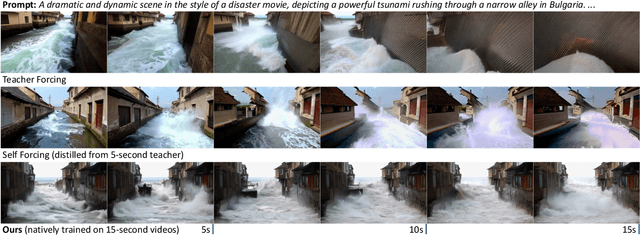
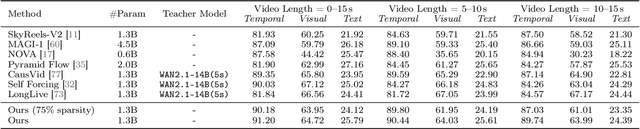
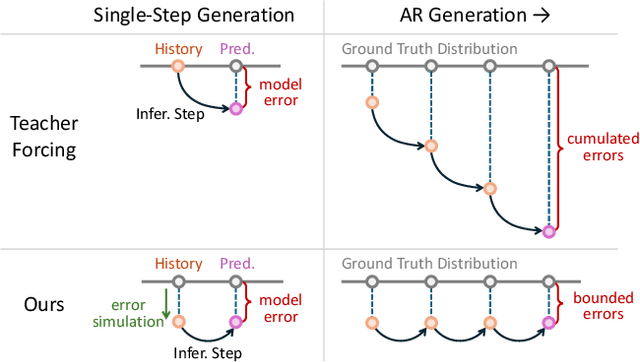
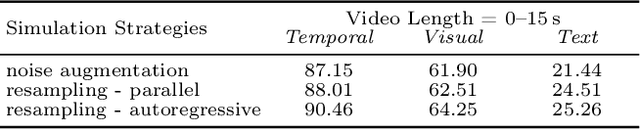
Autoregressive video diffusion models hold promise for world simulation but are vulnerable to exposure bias arising from the train-test mismatch. While recent works address this via post-training, they typically rely on a bidirectional teacher model or online discriminator. To achieve an end-to-end solution, we introduce Resampling Forcing, a teacher-free framework that enables training autoregressive video models from scratch and at scale. Central to our approach is a self-resampling scheme that simulates inference-time model errors on history frames during training. Conditioned on these degraded histories, a sparse causal mask enforces temporal causality while enabling parallel training with frame-level diffusion loss. To facilitate efficient long-horizon generation, we further introduce history routing, a parameter-free mechanism that dynamically retrieves the top-k most relevant history frames for each query. Experiments demonstrate that our approach achieves performance comparable to distillation-based baselines while exhibiting superior temporal consistency on longer videos owing to native-length training.
Composing Concepts from Images and Videos via Concept-prompt Binding
Dec 10, 2025Visual concept composition, which aims to integrate different elements from images and videos into a single, coherent visual output, still falls short in accurately extracting complex concepts from visual inputs and flexibly combining concepts from both images and videos. We introduce Bind & Compose, a one-shot method that enables flexible visual concept composition by binding visual concepts with corresponding prompt tokens and composing the target prompt with bound tokens from various sources. It adopts a hierarchical binder structure for cross-attention conditioning in Diffusion Transformers to encode visual concepts into corresponding prompt tokens for accurate decomposition of complex visual concepts. To improve concept-token binding accuracy, we design a Diversify-and-Absorb Mechanism that uses an extra absorbent token to eliminate the impact of concept-irrelevant details when training with diversified prompts. To enhance the compatibility between image and video concepts, we present a Temporal Disentanglement Strategy that decouples the training process of video concepts into two stages with a dual-branch binder structure for temporal modeling. Evaluations demonstrate that our method achieves superior concept consistency, prompt fidelity, and motion quality over existing approaches, opening up new possibilities for visual creativity.
Taming Flow-based I2V Models for Creative Video Editing
Sep 26, 2025Although image editing techniques have advanced significantly, video editing, which aims to manipulate videos according to user intent, remains an emerging challenge. Most existing image-conditioned video editing methods either require inversion with model-specific design or need extensive optimization, limiting their capability of leveraging up-to-date image-to-video (I2V) models to transfer the editing capability of image editing models to the video domain. To this end, we propose IF-V2V, an Inversion-Free method that can adapt off-the-shelf flow-matching-based I2V models for video editing without significant computational overhead. To circumvent inversion, we devise Vector Field Rectification with Sample Deviation to incorporate information from the source video into the denoising process by introducing a deviation term into the denoising vector field. To further ensure consistency with the source video in a model-agnostic way, we introduce Structure-and-Motion-Preserving Initialization to generate motion-aware temporally correlated noise with structural information embedded. We also present a Deviation Caching mechanism to minimize the additional computational cost for denoising vector rectification without significantly impacting editing quality. Evaluations demonstrate that our method achieves superior editing quality and consistency over existing approaches, offering a lightweight plug-and-play solution to realize visual creativity.
Mixture of Contexts for Long Video Generation
Aug 28, 2025Long video generation is fundamentally a long context memory problem: models must retain and retrieve salient events across a long range without collapsing or drifting. However, scaling diffusion transformers to generate long-context videos is fundamentally limited by the quadratic cost of self-attention, which makes memory and computation intractable and difficult to optimize for long sequences. We recast long-context video generation as an internal information retrieval task and propose a simple, learnable sparse attention routing module, Mixture of Contexts (MoC), as an effective long-term memory retrieval engine. In MoC, each query dynamically selects a few informative chunks plus mandatory anchors (caption, local windows) to attend to, with causal routing that prevents loop closures. As we scale the data and gradually sparsify the routing, the model allocates compute to salient history, preserving identities, actions, and scenes over minutes of content. Efficiency follows as a byproduct of retrieval (near-linear scaling), which enables practical training and synthesis, and the emergence of memory and consistency at the scale of minutes.
Captain Cinema: Towards Short Movie Generation
Jul 24, 2025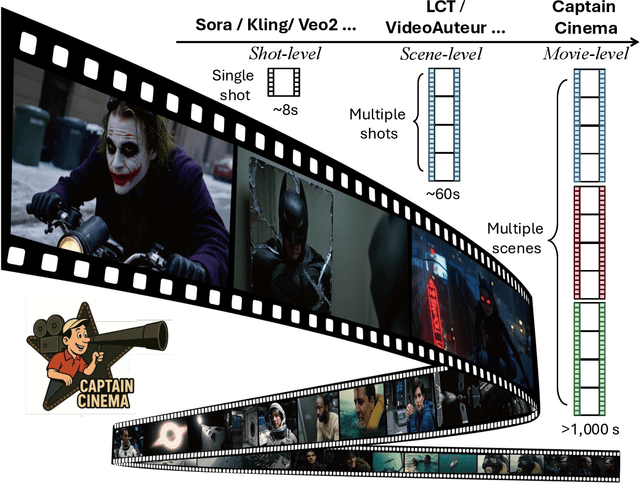
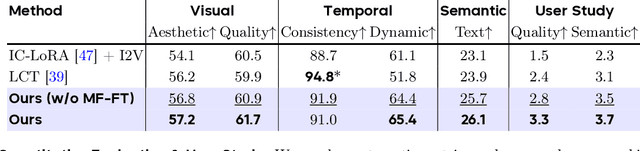
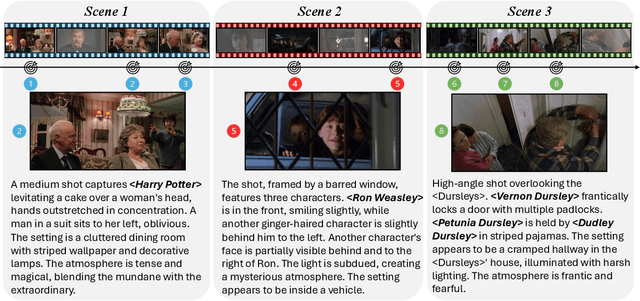
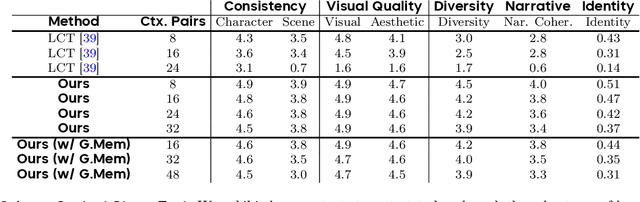
We present Captain Cinema, a generation framework for short movie generation. Given a detailed textual description of a movie storyline, our approach firstly generates a sequence of keyframes that outline the entire narrative, which ensures long-range coherence in both the storyline and visual appearance (e.g., scenes and characters). We refer to this step as top-down keyframe planning. These keyframes then serve as conditioning signals for a video synthesis model, which supports long context learning, to produce the spatio-temporal dynamics between them. This step is referred to as bottom-up video synthesis. To support stable and efficient generation of multi-scene long narrative cinematic works, we introduce an interleaved training strategy for Multimodal Diffusion Transformers (MM-DiT), specifically adapted for long-context video data. Our model is trained on a specially curated cinematic dataset consisting of interleaved data pairs. Our experiments demonstrate that Captain Cinema performs favorably in the automated creation of visually coherent and narrative consistent short movies in high quality and efficiency. Project page: https://thecinema.ai